PART 4 OF 7
The Harlots
Moving through the scrolls of history and of the Old Testament, we have arrived on the other side of Jordan. As discussed in the previous post, the sons of Jacob were now a nation ready to conquer the promised land, and their first stop was the great city of Jericho.
A captivating sight in Matthew’s Messianic genealogy is Rahab. Having already uncovered the story of Thamar, we are now exposed to a detail which ought not to be lost. A rather sensitive one: harlotry. By breaking widowhood, Thamar stepped outside of herself and the Levirate custom’s integrity, and so, Pharez and Zara were conceived. Whenever Rahab is mentioned, she is remembered as the harlot. This creates a tension for the believer, and not only. It is expected that the Bible is a holy book, therefore presenting holiness and righteousness. The Bible does not fall short of the human standard of perfection, and it exposes God’s holy righteousness. And such people as Thamar and Rahab, indeed, have fallen short of both. Nonetheless, God’s grace is made sufficient in humans’ shortcomings. Not that grace requires such fallen situations to be revealed or understood. Rather, the opposite: we can only understand these events because God’s grace, righteousness, and holiness are present and at work.
Rahab’s presence in the Hall of Faith1 shifts the reader’s perspective, reminding them that God’s Redemptive work does not depend on humanity’s fallen state or individuals’ weaknesses and shortcomings.
The Fear of the Lord
9 And she said unto the men, I know that the LORD hath given you the land, and that your terror is fallen upon us, and that all the inhabitants of the land faint because of you.
10 For we have heard how the LORD dried up the water of the Red sea for you, when ye came out of Egypt; and what ye did unto the two kings of the Amorites, that were on the other side Jordan, Sihon and Og, whom ye utterly destroyed.
11 And as soon as we had heard these things, our hearts did melt, neither did there remain any more courage in any man, because of you: for the LORD your God, he is God in heaven above, and in earth beneath.2
The above description of what was happening in Jericho I find rather interesting. Rahab is giving the spies all the strategic intelligence they need: God’s name is feared, and the hearts of the people have melted like wax at the news of the great works God did for his people. Drying up the Red Sea when the Israelites came out of Egypt was something that God did many years before.3 The Israelites wandered through the wilderness for 40 years after coming out of Egypt. Yet, here they are witnessing to nations about God’s works.
Thinking about the Red Sea crossing, it ought to take the reader back to what happened prior to that. God had promised Pharaoh that he was raised on the throne of Egypt for God to make his name known not only to the Egyptians, but to the whole world.4
This is a marvellous picture the Bible portrays now. I see two people, both looking at the Red Sea: Pharaoh and Rahab. Imagine Pharaoh and his army witnessing the waters split and the Israelites walking with their children and their cattle to the other side. Commanding his army to follow, and once the last child of Abraham had stepped out of the dried sea, the waters went back and swallowed the Egyptian army. On the other sea shore, 40 years later, Rahab only heard what Pharaoh saw, and full of the fear of the Lord, she declared, “for the LORD your God, he is God in heaven above, and in earth beneath.”
These were two people faced by the same God with the same evidence, communicated differently and to the measure of the heart. Pharaoh lived in full rejection of God’s wonders. Yet God continued to make his works greater and greater, living without excuse such a hardened heart. On the other hand, Rahab only heard of God’s works at the Red Sea and against the Amorite kings. Her heart melted, and she acknowledged, “he is God in heaven above, and in earth beneath.”5
Rahab’s hearing of God resulted in fear and faith. She not only protected the Israelite spies, but also asked for protection. “Now therefore, I pray you, swear unto me by the LORD, since I have shewed you kindness, that ye will also shew kindness unto my father’s house, and give me a true token.”6 To be placed by oath under the mighty hand of God, knowing that the land she was living in was as if defeated. Extending that protection to her family, she showed a fearful heart toward those close to her.
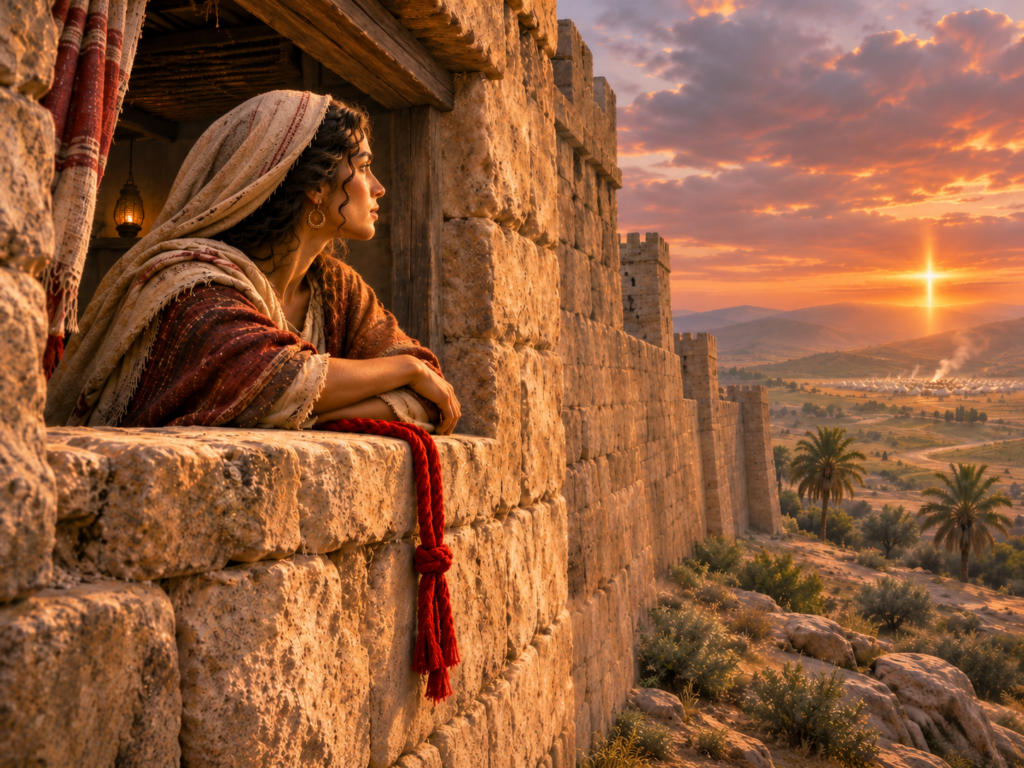
Though it may seem that the walls of Jericho were thick and tall, God would not be stopped by that. Splitting the Red Sea was far greater than destroying the walls of Jericho.
Beyond the Walls
Oftentimes, both men and women are seeking protection in the wrong place. We might as well think that Rahab the harlot might not have had much status and worth in Jericho’s society and much less in Israel, as a prostitute. However, human value does not depend on social status, skin colour, or gender. Human value was established by God upon creating humans in God’s image and likeness. Against all odds, we might ask why God chose such a woman to become the great-great-grandmother of future King David. In the natural course of human history, God is placing himself in it, showcasing his graceful and redemptive character.
Though the people of Israel were a nation and Salmon could have married any other woman from his people, Rahab was the one. His son Boaz seems to have had a good upbringing, as he will step in his father’s shoes and apply his mother’s advice. To seek for a wife, a woman faithful to God first and his people.
Rahab’s legacy is found all throughout the Bible, and the most marvellous is the Messiah. However easy would it be to conclude that, in this instance, Rahab’s faithfulness was what, perhaps, motivated God to rescue her and place her in the Royal Davidic and Messianic bloodline. God’s plan and mind are above human understanding. But what we can confidently see in this story is that faith in God removes walls; the fear of the Lord steers to wise decisions7; God is a reward for those who diligently seek him.
Lived to this day
It has taken Joshua and the people of Israel a few weeks, if not more, to cross the Jordan River, set up the camp and go and conquer Jericho. In all this time, Rahab had to wait for the promise to be fulfilled. My mother once said, “Life loses its beauty without something to look forward to.” There are situations when this realisation comes after the trial. We ought to understand and start living looking forward and beyond. That is what Christian life is defined as: to have our minds set on things above.8
In the midst of the battle, Joshua commanded his men, the spies, to go and rescue the harlot. And so they did; together with her mother, father, brethren and all they had, she was spared and given refuge in the Israel camp. Rahab the harlot lived long enough that when Joshua’s memoirs were written, the scribe noted down that she was among the Israelites.9 However, these were not rewards God had prepared for Rahab the harlot. Because God is a rewarder, He defines the measure. Hence, Rahab the harlot will be remembered throughout Israel. What is more, she is placed at the root of the son of David, Jesus Christ. This further speaks a foundational truth: grace, restoration and reconciliation.
Rahab the harlot, hearing about God’s marvellous works, not only had a change of mind, but a change of heart too. I think she is remembered as the harlot, to point to a specific moment in history. Alongside her, Joshua, God will come to people’s minds, and the fall of Jericho. However, finding asylum in Israel and marrying Salmon, the son of Nahshon, the son of Amminadab, the son of Ram, the son of Hezron, the son of Perez, the son of Judah, begat of Thamar, Rahab left behind the old Canaanite lifestyle. Had she continued in harlotry after marrying Salmon, she would have been guilty of adultery, an offence punishable by death under the Mosaic Law.
In the midst of this historical event, we can identify God restoring a prostitute being restored through faith in God. Reconciled and adopted in the nation of Israel, God’s people. Given the grace to become a daughter of the Most High God.10
Bible References
PART 4 OF 7
NEXT IN THE SERIES · Feminism and Femininity – From Promise to Fulfilment
PART 5 OF 7 · Ruth, Kindness Beyond Kindred – Continuing our exploration of the woman’s significance in God’s unfolding redemptive purposes.
- Read PART 1 – Feminism and Femininity – The Grace of Judgement
- Read PART 2 – Feminism and Femininity – Eve, the Mother of All Living
- Read PART 3 – Feminism and Femininity – Thamar, Preserving the Royal Line
Discover more from AvA blog
Subscribe to get the latest posts sent to your email.