In the Beginning Grace
The Scriptures played a vital role in the spread of Christianity during the first century. In the book of Acts, we read that the apostles, Paul, and many others preached and showed from the Scriptures that Jesus of Nazareth was the Messiah. This was not an invention, a coercion of the text, or imposed hermeneutics introduced into the Scriptures by the apostles and the first-century disciples. Rather, it was a continuation of the work Jesus had already begun during his earthly years of ministry. Jesus proved himself to be the Messiah and God by reasoning and showing from the Scriptures, as well as by fulfilling the prophecies concerning the Messiah, such as healing the blind and raising the dead back to life. Lastly and most importantly, Jesus was born of a virgin, died upon the cross and rose from the dead, according to the Scriptures1.
The numerous numerous prophecies concerning the Messiah are rooted within the Old Testament. This is what is meant in the New Testament by the Scriptures: the Hebrew Bible, which Christians have received and preserved as the Old Testament. It is not old because of its age, nor because it is expired, irrelevant or out of use. On the contrary, it is the Old Testament because it speaks about God and his plan of redemption through the Messiah from the dawn of humanity.
The first prophecy about Jesus the Messiah is found in Genesis 3:152. One of the most compelling statements in the Bible. The whole context depicts a marvellous picture about grace, hope, redemption and final victory. A promise and a prophecy which looks beyond the cross to the final crushing of Satan. This has traditionally been called the protoevangelium3. The people from the Old Testament era were saved by faith in the promised Messiah. Whereas, the people from the church era, are save by faith in the given and glorified Messiah. There have never been two ways of salvation: in both eras, salvation is, and has always been, by grace through faith in the Messiah.
Proceeding Events
Through time spent in the Bible, I have discovered that the Old Testament contains many persons, situations and events which later Scripture discloses as corresponding to Jesus Christ. This is known as biblical typology4. It can be seen especially within events from the lives of people such as Abraham, Isaac, Jacob, Joseph and many others. Biblical typology concerns historical persons, events, institutions or patterns which possess their own genuine meaning within their original textual context, but which later revelation discloses as corresponding to and anticipating a fuller reality ultimately revealed in Christ.
Such events present us with a great depth of reflection, inviting us to stop and allow them to sink into our minds. For those in olden times who lived through them, these were life-changing experiences, as they certainly were in the life of Abraham. We will therefore stop and meditate upon one particular and momentous event which is remembered and rehearsed in the apostolic writings: God asking Abraham to bring his only son Isaac as a burnt offering. Without any hesitation recorded in the narrative, Abraham did what God commanded him to do. Isaac was his only and beloved son, not just because he was the promised son, but because through his birth God had fulfilled his promise to Abraham and Sarah. God had demonstrated his faithfulness to Abraham. Now Abraham’s faith in the faithful God was to be tested.
One interesting point to highlight is that, after Abraham does what God commanded and brings Isaac to be offered as a sacrifice, the very next chapter records Sarah’s death and burial. Much discussion has centred on how old Isaac might have been at the time of the offering. Yet perhaps the more striking narrative observation is what Genesis places immediately afterwards: the death of Sarah.
Commentators have often attempted to make a connection between the binding of Isaac and Sarah’s death, some even suggesting that the events surrounding Isaac may have contributed to it. Such a possibility should not necessarily surprise the reader. After all, one’s only son being taken away to be offered as a sacrifice would hardly have been an easy thing for an aged mother to bear.
The Bible, however, does not tell us whether Abraham informed Sarah beforehand about what God had commanded him to do. He may have told her, or he may have withheld it from her. Nor does Scripture tell us whether Sarah somehow perceived that something was wrong, as a mother might sense concerning her son. These remain possibilities, not statements of the text. A biblical narrative does not record every circumstance surrounding an event, but what it leaves unspoken cannot be assigned the same interpretive authority as what it explicitly reveals. These possibilities must therefore remain secondary and bear little or no theological weight.
What the narrative does give us is a very close literary sequence: Isaac is taken to Moriah, Abraham returns, a brief notice concerning Nahor’s family is given, and then Sarah’s death and burial are recorded in Genesis 23. Scripture does not tell us exactly how much time passed between Isaac’s return and Sarah’s death. We should not convert literary proximity into a precise chronology. Nevertheless, Genesis places her death within the immediate literary aftermath of one of the most extraordinary events in the lives of Abraham’s, Sarah’s and Isaac’s lives.
The Offering
Let us now focus on Isaac and Abraham walking up the mount Moriah. Isaac, an young man carying the wood for the burnt offering. Abraham, a man in his old days, slowly walking up the mount holding the fire and the knife. Once they reach the place God had shown him, Abraham builds the altar, arranges the wood, binds Isaac and lays him upon it. Although the text does not tell us what passed between them, it seems possible that Isaac willingly accepted what was about to happen.
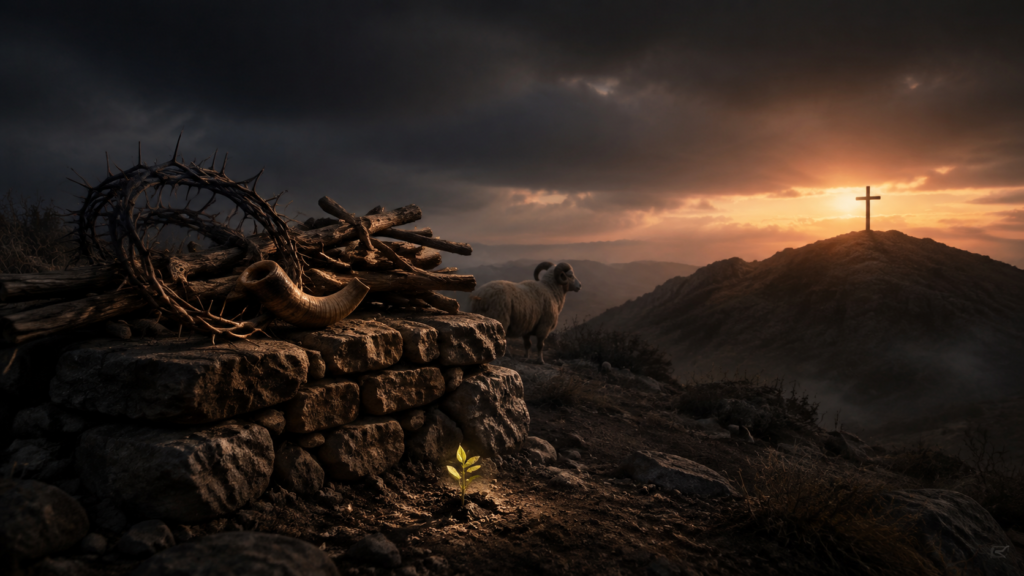
On their way unto the place, it is Isaac who asks about the lamb for the burnt offering. To which Abraham answers that God will take care of the lamb to be given as burnt offering. Abraham’s answer to his son Isaac, ehoes till today. In John chapter 1 we read about the lamb of God who taketh away the sin of the world.5 After Abraham is stopped from harming Isaac, he lifts up his eyes and sees behind him a ram caught by its horns in a thicket. Whatever the extent of their theological understanding at that moment, Abraham and Isaac experienced the reality of substitution: the ram was offered in Isaac’s stead. Millennia after this event, we see God give his only begotten Son as the sacrifice.
Isaac is bound and laid upon the altar. The wood is arranged beneath him, and Abraham takes the knife to slay his only son. The narrative has now reached its most terrible moment. It is difficult to imagine what was in Abraham’s heart and mind when he took the knife to slay his son. It is equally difficult to imagine Isaac, bound and lying upon the wood, witnessing his father take the instrument of his death. We may imagine him looking upon the one he had always known as his provider and protector, now holding the knife above his beloved son.
“Lay Not Thine Hand”
As much as it may sound like a fairy-tale story, this life-changing event was actually lived by Abraham, Isaac and the servants who accompanied them on the journey. Its effects may also have reached Sarah, although Scripture does not tell us what she knew. Heaven was certainly involved, for the angel of the LORD called unto Abraham from heaven; and I would like to think that the host of heaven was watching as well. We can only imagine what it was like in heaven as Abraham walked up the mountain, built the altar, bound his son and then took the knife. Our emotions and thoughts may go on a roller coaster, yet we must control them so that imagination does not become a claim of Scripture. We may imagine how slowly or quickly Abraham walked, whether there were tears, distress, anxiety or a darkened countenance as he looked upon the death that was yet to come by his own hand. These details, however, remain hidden from us.
Nonetheless, in the midst of all that, I was challenged to reflect upon two events in parallel: Isaac’s binding and Jesus’ cross. Although the events correspond in many ways, their decisive outcomes are completely opposite
Isaac’s binding ends with him being spared by Abraham at God’s command to not lay his hand on the lad or do anything to him. The narrative continuing with stating the following: “for now I know that thou fearest God, seeing thou hast not withheld thy son, thine only son from me”. This is God speaking in a declarative-descriptive way to Abraham. Declaring what was sought in the begining, when God tempted6 Abraham to bring his son, his only son as a burnt sacrifice, at end God declared that what Abraham was called to do, was done.
It is amazing to see God’s intervention in this event. It gives the reader an indication that God’s intent was not for Issac’s life to be given, rather the focus of the story is on Abraham. Later on, the author of Hebrews, inspired by the Holy Ghost, reveals that Abraham’s faith was tested. Abraham believing that God could raise Issac from the dead, in the light of the promise God made to Abraham in Genesis 157. That “he that shall come forth out of thine own bowels shall be thine heir”. Then inviting Abraham to look toward heaven and number the stars. God painiting a marvelous picture and declaring to Abraham that so shall thy see be8. So that at the end of God’s encounter with Abraham, is declared that Abraham belived God and it was counted as righteousness.9
It ought not to be to wonder why God is asking Abraham to bring as a burnt offering the promised son, who will be the heir of his house and the seed from who God will raise a nation and bring the Saviour Jesus Christ into the world. God was testing and proving Abraham’s faith, not in general, but in relation to the specific promise of an heir. What is more, this made me reflect back on Ishmael. Abraham and Sarah had previously attempted to secure through human means what God had promised to provide, going against the promise God made. Therefore, Isaac being promised twice, now Abraham was at the very moment where I think he understood that God is faithful to his promises. Because the keeper of the promise is not the one on the receiving end, but God. Bringing himself into the commintment of what is promised to be deliverd. Therefore, although Isaac was as good as dead once laid upon the altar, God was demonstrating his faithfulness to Abraham while Abraham’s faith in the faithful God was being tested. Abraham was already looking beyond Isaac and beyond death.
The voice from heaven at that very moment must have brought extraordinary relief. I am inclined to believe that the first and most immediate relief was that Isaac would not be killed or harmed. Most importantly, God is faithful. Could God raise Isaac from the dead? A question with an obvious answer and Scriptural evidence.10 The emphasis, however, is not merely on if God could make a miracle out of Isaac, but that Abraham was now at the point where I think, he knew God intimately and was not doubting him. Thinking at the option that if Isaac was to die, God would be able to raise him from dead. Through whatever means, Isaac was to live long enough to have children of his own.
The event reaches its full emphasis when the ram is offered as a burnt offering in Isaac’s stead. When Isaac had asked about the lamb, Abraham assured him: “God will provide himself a lamb for a burnt offering.” The immediate provision upon Moriah was a ram, which Abraham offered instead of his son. Yet Abraham’s words echo beyond that mountain, directing the reader toward the Lamb of God who was yet to come.
“Eloi, Eloi, Lama Sabachtani”
Many people today understand the words Jesus cried from the Cross: “My God, my God, why hast thou forsaken me?” 11. Jesus was uttering the opening words of Psalm 22, placing his suffering within the testimony of the Scriptures. At the time, however, some of those standing nearby did not hear his words as they were meant. The two Gospel accounts which record this event tell us that they thought Jesus was calling for Elias—the prophet Elijah—and waited to see whether Elijah would come to take him down.
What strikes me is the moment at which Jesus lifts up his voice toward heaven. I have learned to stop and read every word of the Bible, because every detail matters. We read that from the sixth hour there was darkness over all the land unto the ninth hour. And about the ninth hour is when Jesus cried with a loud voice, saying, Eli, Eli, lama sabachthani?12.
On a personal note, when I look upon this event and the three hours of darkness, serious questions arise upon which to reflect. It was a one-of-a-kind moment in human history, calling the meticulous reader to stop and meditate upon it. The mind and heart are stretched back to the genesis of the universe, into the prophecies concerning the Messiah, and toward what Jesus had claimed concerning himself.
Such as, after the Universe was created, light was created within.13 The prophet Isaiah states that people that walked in darkness have seen a great light: they that dwell in the land of the shadow of death, upon them hath the light shined14. Looking therefore, upon the one who shall be called Wonderful, Counsellor, The mighty God, The everlasting Father, The Prince of Peace15. When the wise men from East came to Jerusalem they were led ther by the his star16.
Moving forward, John testifies that God sent not his Son into the world to condemn not the world; but that the world through him might be saved17. Therefore, the world being darkness when light came within, by it’s rejection and loving rather darkness than the sent light, by not believing in the only begotten Son of God, it is condemned already18. And lastly, Jesus said that I am the light of the world: he that followeth me shall not walk in darkness, but shall have the light of life19. It becomes evident at this point that God is light, and in him is no darkness at all20.
Why then was the land overtaken by darkness when from the sixth hour until the ninth hour? The light of the World, the Prince of Peace was there upon the altar; why then did darkness cover him? Looked upon from the nature and charater of God, this produces deep theological reflection. Some sceptics may attempt to explain the darkness as merely a natural event, but the Gospel narrative does not present it as a detached coincidence. Why did Jesus, while hanging upon the Cross, cry out that God had forsaken him? After those three hours of darkness, and not long after this cry, Jesus cried again with a loud voice and yielded up the ghost21.
Heaven and earth were witnesses to the scene. quite and mute at the scene. Yet at its decisive moment, no voice came from heaven saying, “Lay not thine hand.” Some waited to see whether Elijah would come and take Jesus down, but no Elijah came. The hand of the Father bruised22 the Son and did not spare23 his only begotten Son in whom the Father was well pleased24. This time, divine justice was to be made and satisfied. The Father did not hold back, nor could anything stop him, because for God so loved the world, that he gave his only begotten Son, that whosoever believeth in him should not perish, but have everlasting life25.
The Last Breath
I think of Isaac, how he may be looking back at the mount Moriah, where his last breath was spared. The angel of the Lord called out unto his father to not lay his hand upon him26. Isaac went home along with his father, perhaps full of joy and wonder of what they both experienced.
On the contrast, it stands Jesus Christ and his Father, separated for while. Jesus walked down the mount carried by others and unknown to us what might’ve happened in the highest heavens. Because, we are on the receving end of the greatest work and promise God did within our mere existence.
I often meditate upon those three hours of darkness and the forsakenness expressed in the cry of Jesus. Yet I hesitate to say that the intimate fellowship of the Holy Trinity was broken, because Scripture does not reveal an ontological division within God. The Father did not cease to be the Father, nor did the Son cease to be the Son. Nevertheless, the cry of Jesus was neither empty nor theatrical. While willingly bearing humanity’s sin and laying down his life, Christ entered a depth of suffering and forsakenness which we may not fully comprehend until we are with him in eternity.
There it was on full display, to the local audience, the promised seed to Abraham through Isaac who was not harmed on the mount Moriah, Jesus Christ the Lamb of God. The words of father Abraham, now echoed in Jesus cry out to his Father. Just as Isaac was inquiring of Abraham about the lamb that was missing, Jesus was inquiring why the Father has forsaken him. Silence was the answer Jesus got and it echoes untill today.
Though Heaven was silent when Jesus was on the cross crying out. The cross speaks over the centuries and millenia with a louder voice. And louder than that is the emptiness of the Jesus grave. ‘He is not here’ said the angel to the women. Jesus Christ was not left on the cross nor in the grave, but arose from the dead, because death could not contain him. The wages of sin is death for the sinner. But Jesus took my sin and the entire world’s brokeness upon him, therefore, death could not imprison Jesus the Saviour. It rather turned the odds against death. Jesus conquiring it so that whoever believes on him, shall be saved. The wage of sin bears no weight on the believer, because all the weight was carried by the Lamd of God.
Bible References
- 1 Corinthians 15:3-4 ↩︎
- Genesis 3:15 ↩︎
- from Greek prōtos (“first”) and euangelion (“gospel” or “good news”); the term is not found in Genesis itself; it is the traditional Christian designation for Genesis 3:15 as the first announcement of God’s redemptive purpose ↩︎
- Biblical typology is a method of interpretation in Christian theology where people, events, and institutions in the Old Testament are seen as symbols or “types” that foreshadow and find their ultimate fulfillment (“antitypes”) in Jesus ↩︎
- John 1:25 ↩︎
- Genesis 22:1;
– heb. nâsâh: a primitive root; to test; by implication to attempt: – adventure, assay, prove, tempt, try
– gre. peirazō: from peira (from the base peran, a derivation of peirō, meaning to pierce through, across); to test (objectively), that is, endeavor, scrutinize, entice, discipline: – assay, examine, go about, prove, tempt (-er), try. ↩︎ - Genesis 15:4 ↩︎
- Genesis 15:5 ↩︎
- Genesis 15:6 ↩︎
- Hebrews 11:19 ↩︎
- Mark 15:34 ↩︎
- Matthew 27:46 ↩︎
- Genesis 1:3 ↩︎
- Isaiah 9:2 ↩︎
- Isaiah 9:6 ↩︎
- Matthew 2:2 ↩︎
- John 3:17 ↩︎
- John 3:18-19 ↩︎
- John 8:15;John 9:5 ↩︎
- 1 John 1:5 ↩︎
- Matthew 27:50 ↩︎
- Isaiah 53:10 ↩︎
- Romans 8:32 ↩︎
- Matthew 3:17 ↩︎
- John 3:16 ↩︎
- Genesis 22:11-12 ↩︎
Further Reading
- T. Ernest Wilson, “Abraham and Mount Moriah, Gen. 22” (Precious Seed, 1987) – Directly contrasts the heavenly voice stopping Isaac’s death with heaven’s silence at Golgotha. It also discusses Abraham’s tested faith, resurrection reasoning, the ram as a substitute and Christ as the Son not spared.
- Dan Rudge, “Foreshadows of Christ and Calvary: A Typical Place—Moriah” (Truth & Tidings, March 2019) – It contrasts the cry from heaven which stopped Abraham with Christ’s double cry ascending from earth during the darkness. It also moves from Genesis 22 to Psalm 22 and Romans 8:32.
- Warren Gage, “Where Is the Lamb?” (Tabletalk/Ligonier, December 2006) – Develops Isaac’s unanswered question, the distinction between the promised lamb and the provided ram, John 1:29, substitution, the beloved son and the Son who was not spared.
- Glen Scrivener, “‘Kill Me a Son’: The Beautiful Scandal of Abraham’s Sacrifice” (The Gospel Coalition, November 2018) – It argues that Genesis 22 must be read within the testimony of the whole Bible to Christ. It follows the promised seed from Abraham through Isaac to Jesus and stresses that Isaac carries the hope of the world.
- Erich Auerbach, “Typological Symbolism in Medieval Literature”– Auerbach explains that typology is not allegory: both the earlier event and its later fulfilment remain real historical events. He uses precisely the sacrifice of Isaac and the sacrifice of Christ as his example. The original essay appeared in Yale French Studies 9 (1952), pp. 3–10.
Discover more from AvA blog
Subscribe to get the latest posts sent to your email.