
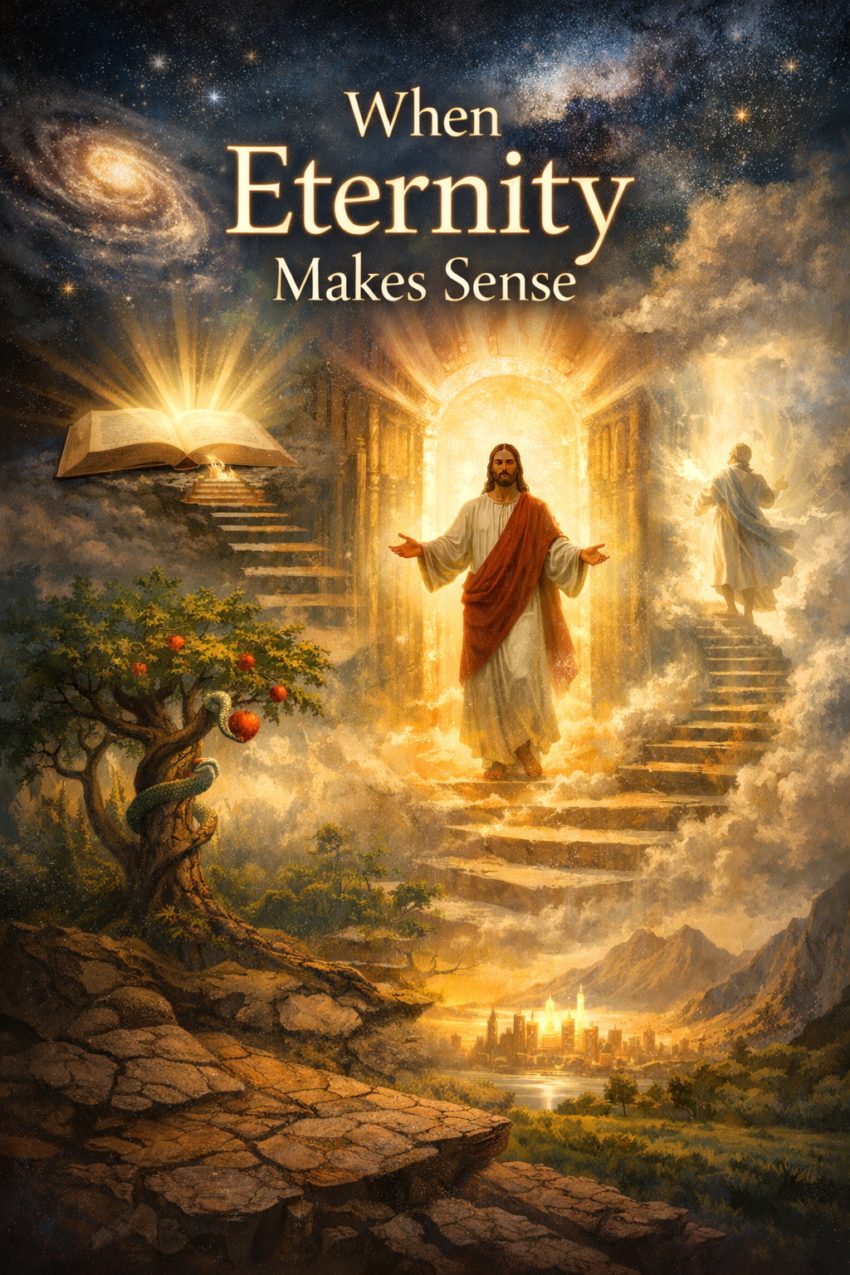
“In the beginning was the Word, and the Word became flesh.”
Seasoned thinking
As I navigate social media and online publishing platforms, I have noticed that with the beginning of a new year, articles, posts, and discussions from the book of Genesis come into the spotlight. Both believers and non-believers seem to resonate with the book of beginnings, with particular focus on the first three chapters—the very bedrock of the theistic and Christian worldview.
Some authors invest great effort in exposing what they call “contradictions” in Genesis 1–3. Others, writing in a more devotional tone, highlight the beauty of Genesis 3 and argue that it is too often read through a purely negative lens. In the midst of these weighty discussions, I turned to a few Bible commentaries, only to discover that the arena of reasoning is more tense than I expected.
Even scholars and biblists wrestle with these chapters—either attempting to reconcile Genesis 1–2 with science, explaining various gap theories, or even speculating about subjects such as the fall of Lucifer prior to Genesis 1:2, which they suggest resulted in chaos, void, and darkness. In recent years, I have learned that whatever authority a Bible scholar, researcher, or commentator may carry, they will never stand above the Word of God.
The Bible reveals that the Word is Truth incarnate. Therefore, in the marketplaces of thought, we ought to engage others with confidence and encouragement, grounded in the knowledge of the true Truth. This Truth is not a concept, nor an age-developed philosophy or theology. The Word and the Truth are one and the same — the person of the prophesied and promised Messiah.
“In the beginning was the Word, and the Word was with God, and the Word was God.
The same was in the beginning with God.
All things were made by him; and without him was not any thing made that was made.
In him was life;” – John 1:1-4a
Reasoning with the Intelligible
Apostle John enables today’s readers, Bible students and thinkers of any background to look beyond Genesis 1:1 and reflect on what preceded creation and Christ’s incarnation. There are moments when the idea of eternity feels abstract—too large, too distant, or too disconnected from ordinary human life. For many modern readers, eternity belongs either to philosophical speculation or religious sentiment, but not to lived experience. Apostle John opens his gospel account by reiterating what Genesis 1 has stated for thousands of years. What was known in oral tradition before it was ever written. He did not produce the Logos; Apostle John is merely translating into the fulfilled reality what and who the Word was. Its origins and enactment, creating an arch over time, mirroring the Jesus of Nazareth, as the cause of the Universe.
However, this idea, Jesus of Nazareth, the cause of the Universe, is not strange to the Bible nor to church tradition or today’s believers. The Bible insists that eternity is not merely a future reality; it is something that presses into the present. Preceded the beginning, and God is the indweller who, through His only begotten Son, has translated it into the limit of the human mind.
From The Beginning to the End
“He hath made every thing beautiful in his time: also he hath set the world in their heart, so that no man can find out the work that God maketh from the beginning to the end.” – Ecclesiates 3:11, KJV
The claim is bold. Though humanity cannot fully contain within its comprehension God’s work from the beginning to the end, the Creator has placed the thought of eternity in the human heart. Not that eternity itself can be grasped, but that its vastness and incomprehensibility can only exist there as a longing. People today spend enormous effort trying to understand eternity. What a paradox—how much time can one devote to understanding the limitless?
Amid all humanity’s labor to reason with eternity, God has spoken, translating eternity for us:
“1Long ago, at many times and in many ways, God spoke to our fathers by the prophets, 2but in these last days he has spoken to us by his Son, whom he appointed the heir of all things, through whom also he created the world.” – Hebrews 1:1-2, KJV
Jesus is the Logos of eternity entering time. What is striking about this claim is that to transcend time, one must fully know both dimensions—eternity and temporality. Eternity, however, is not entirely unknown to human perception. Creation itself offers a glimpse. The vastness of the universe, both in the macro of cosmic space and the micro of atomic structure, lies increasingly within human sight and understanding. Yet even here, limits remain. The horizon keeps moving, but it never disappears.
The Logos, Jesus Christ, translated from eternity into time, opened heaven from the inside. Therefore, when He said, “I am the way, the truth, and the life: no man cometh unto the Father, but by me” (John 14:6, KJV), Jesus was declaring a reality that had already happened and, at the same time, proclaiming the possibility of entering heaven by acknowledging that He is the incarnate Logos and Truth. This is where the belief that human beings can construct their own way to heaven collapses. One may build a ladder to reach heaven’s door, but that will never justify walking in heaven, for it is opened from within, not from without.
This pattern is present from the beginning. In Genesis 3:15, as God pronounces judgment upon the serpent, He also proclaims redemption. The seed of the woman would be wounded, yet would crush the serpent’s head. Judgment and grace emerge together. God’s judgments are protective in character and precise in timing. Even in humanity’s fall, God reveals redemption—not as mere intent, but as a promise certain to be accomplished in Christ through His death and resurrection. This is the gravity of the Old Testament: Christ is both prophesied and promised throughout its pages, and faith in God’s promised spoken Word is what translated figures such as Enoch into heaven, long before the incarnation.
Salvation, therefore, is eternal because Jesus is eternal. It follows the pattern of Genesis 1—“And God said.” All things were spoken into existence, the greatest and most unexplained miracle. Perhaps it is one we will only fully understand in eternity, in the presence of Christ, both Creator and Redeemer.
When Eternity Makes Sense
“Believe in the Lord Jesus Christ and though shall be saved.” (Acts 16:31).
The gospel comes to us as a message, reminding us once again of the power of words. Behind every message stands a mind. Behind the gospel stands the Logos—the One who spoke all things into being. Salvation, therefore, carries meaning beyond time, space, and matter, because it is rooted in the eternal Word who entered time so that eternity finally makes sense.
Discover more from AvA blog
Subscribe to get the latest posts sent to your email.