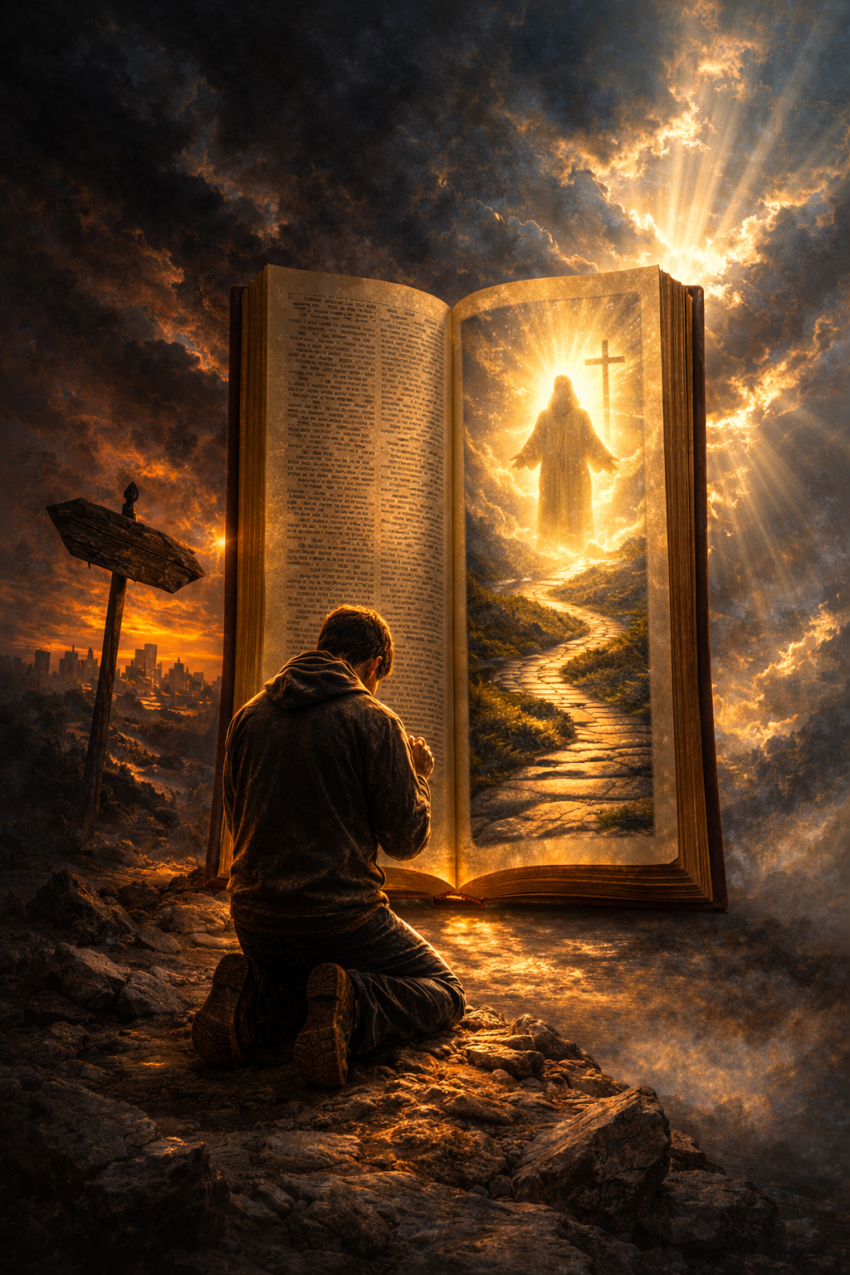
Thy word is a lamp unto my feet, and a light unto my path. Psalm 119:105
The Biased Tension
Since the beginning, there has been a conflict between the will of man and the will of God — between what we desire and what God commands, instructs, and prescribes for life. Human freedom, when exercised independently of God, shifts the centre of truth from the Divine to the self. In doing so, truth becomes internalised, relativised, and reshaped according to preference. Right and wrong lose their fixed reference point, and meaning begins to fracture.
Recently, I was confronted again by the Word of God and challenged to reconsider a fundamental principle of life. It became clear that this principle must rest at the bedrock of faith. A believer’s foundation does not shift, for it is established in God through Christ. Yet there are seasons when that foundation is reinforced within us — when the Word re-anchors the soul in life-sustaining truths. There are moments when maturity in Christ takes an up-turn — when conviction rises after a deep search for meaning, and growth becomes evident not merely in knowledge, but in alignment.
We may experiment with design and decoration, but a house’s foundation and structure are non-negotiable. Without them, no aesthetic refinement can preserve the building. So it is with faith. Too often we invest in appearance while neglecting structure. Scripture is not a pot of paint to colour our preferences. It is the foundation and the structural blueprint — and God Himself is the Architect.
My Path
When we move away from the Creator of the universe, truth begins to lose its weight, its clarity, and ultimately its purpose. Detached from its Source, meaning does not disappear immediately — it weakens gradually.
Not long ago, while attending a morning service and listening to a sermon from Psalm 119, I noticed a striking harmony within the text. The psalmist continually expresses gratitude. He does not merely obey God’s Word; he delights in it. He blesses God for granting him such depth of understanding, as though divine instruction were not a burden but the pathway to wisdom and life.
And here the tension rises.
For many believers, Scripture often does not feel less like harmony and more like confrontation. There are moments when reading the Word seems like a quiet competition between my path and God’s Word — as though His instruction does not quite fit the direction I have chosen. At times, we subtly resist His testimonies, statutes, and commands. At other times, we recognise that our path does not align with His Word, yet we hesitate to yield fully and trust Him to direct our steps.
Thus, the tension intensifies. Awareness grows heavier. Conviction presses deeper — until we reach a tipping point, where the path we walk becomes dangerously unstable. And yet, it remains my path, altered only by the will of the one who walks it.
As the tension increases, trust begins to erode. Purpose narrows. Meaning fades into a distant echo.
At such a moment, we begin to realise that the path itself is the outcome of an isolated will — a will detached from the Word, a trust misplaced, a freedom misused. It is not that the path was left unguarded; rather, the walking has become weary and misdirected. What once felt like progress now feels like tireless dragging.
Thy Word
The fundamental truth revealed in Scripture is that my path was never meant to exist as an isolated entity from Thy Word. God’s will is not merely that we know His Word, but that we live in harmony with it. When the path is aligned with the Word, tension dissolves. The path is no longer self-designed but divinely directed. In such harmony, the path reflects the Word, and the Word illuminates the path. This is the essential testimony woven throughout Psalm 119 — not reluctant obedience, but joyful alignment.
Harmony between the path and the Word is the most fulfilling choice free will can make. Trust finds its completion there. Freedom finds its proper direction.
Yet we are easily deceived into believing that the path must be designed by the walker alone. We assume autonomy is maturity. But life lived in tension with the Word makes every step feel heavy — as though walking upon hardened stone, leaving marks of strain behind. Christ, however, declared that He came to give life — and life more abundantly.
Proverbs 22:6 instructs: “Train up a child in the way he should go: and when he is old, he will not depart from it.” The emphasis is not merely on information, but formation. To train is not simply to teach words, but to cultivate a way — a lived pattern shaped by truth. Knowing alone does not transform; living what is known does. Many are familiar with the Word, yet few allow the Word to shape their walk.
Christ declared, “I am the way, the truth, and the life.” In Him, the path is not merely directed — it is embodied. Through His teachings, He revealed the will of the Father; through His obedience, He fulfilled it. He walked toward the cross when the weight of the world’s sin pressed heavily upon Him — a weight I understand personally, for my own sin was laid upon Him, though its full measure remains beyond me.
The Holy One bore upon Himself the sin that brought death to humanity. He who knew no sin entered death not as its captive, but as its conqueror — rising victorious to redeem all who believe. In Christ, the way to life is not constructed by human effort; it is opened by divine sacrifice. Through Him, we are reconciled to God and invited into life eternal.
The three hours of darkness at midday were not mere atmospheric signs; they were a solemn witness to the gravity of sin and the cost of redemption — a shadowed moment revealing the depth of what was borne upon the cross.
The Mirror
Each Christian is called to be Christlike — to live and walk as Christ walked. Yet not blindly. Our Lord did not leave us without a witness; He displayed in full clarity the perfection of obedience, humility, and truth. Through Christ — trusting Him for redemption, and depending upon Him for growth — life gains not merely direction, but heavenly meaning.
If the Word is the foundation and the path its direction, then the walker’s motivation must be Christ Himself — Lord and Saviour. Self-examination, therefore, is not comparison with others, but reflection before Him. I am to examine myself in the light of Christ alone, allowing His character to shape what is formed in me — by grace, through faith.
Scripture does not merely inform; it reveals. When we stand before it honestly, it reflects not only what we know, but who we are becoming. The tension between my path and Thy Word becomes visible there. What once felt justified is exposed. What seemed harmless reveals its fracture lines. The instability of the path is no longer theoretical — it is reflected back to the walker.
James writes that the one who hears the Word and does not act upon it is like a man who looks at his face in a mirror and, having seen himself, immediately forgets what he looks like. The tragedy is not ignorance — it is recognition without transformation.
A mirror does not distort. It does not flatter. It does not negotiate. It simply reflects. Either I adjust the mirror to preserve my path, or I adjust my path to reflect the Word.
When the Word becomes the mirror, self-deception weakens. Alignment becomes possible. The path is no longer defended — it has been surrendered. And in that surrender, harmony is restored.
“If ye then be risen with Christ, seek those things which are above, where Christ sitteth on the right hand of God.” Colossian 3:1
To seek those things above is not to escape the path below, but to walk it differently — directed by the Word, sustained by grace, and reflected in Christ.
Discover more from AvA blog
Subscribe to get the latest posts sent to your email.